血陰密敎 · The Blood Yin Esoterics
'To be seen is to die'
They developed poison and blood qi, meridian arts and meridian-stripping, concealment and infiltration, and vanished from the world's sight.
 ONLINE
04 · THE CHRONICLE
Memory of an ancient martial learning that began in myth became legend; legend became sects; and the order the sects built shook the whole jianghu again.
Nobody knows where the history of the jianghu should begin, because the oldest records are already written not as history but in the language of myth.
In the East, tales of Hwanguk and Hwanung, of Baedal and Sinsi and Dangun, were handed down from very long ago: people who made offerings to heaven, ascetics said to have read the energies of nature deep in the mountains of Baekdu, ancients said to have trained the body by watching how animals moved.
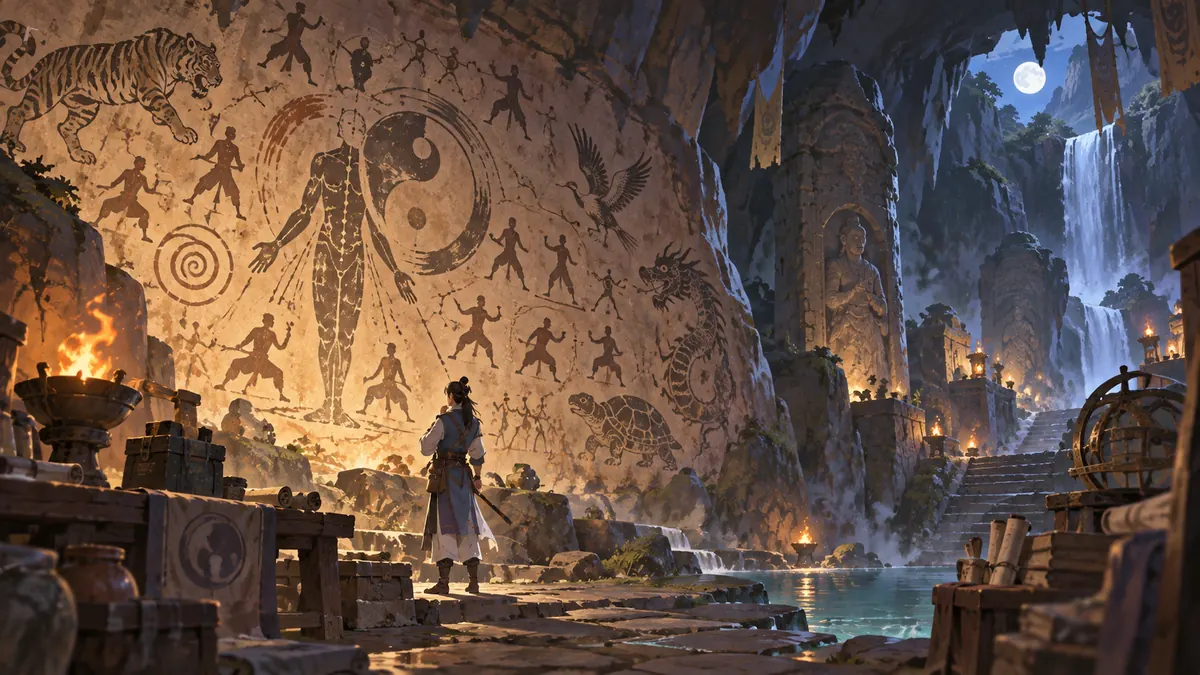
Whether that is the memory of some real age or a myth assembled from the tales of many generations, nobody today can prove. But there was one strange thing. In old murals and oral traditions found in quite separate regions, postures that call to mind the later breathing methods and footwork appear again and again.
And at the end of those old tales one name always lingered faintly.
He took up a sword but used no swordsmanship; he threw a fist, and none could say which fist art it was.
Later scholars of martial learning read this as 'the martial before form existed' — that what was taught was not any particular form but the underlying principle by which a person exerts power, moves, and reads another's flow.
達磨
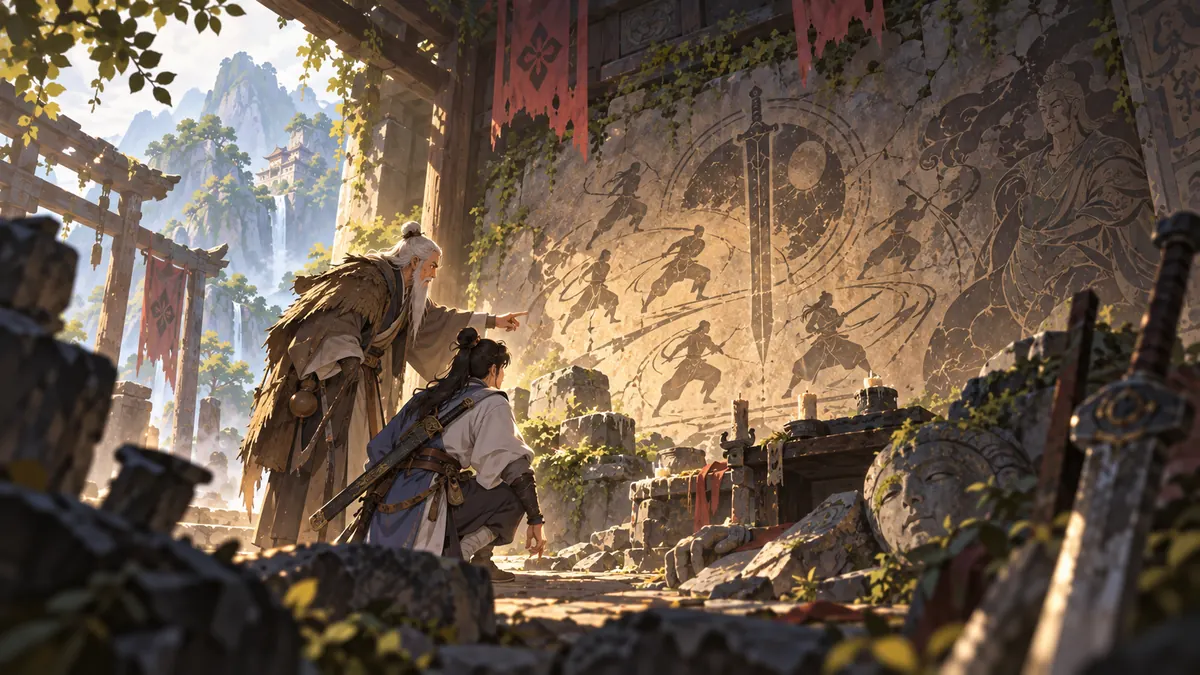
Ages later a monk encountered the old transmission of the East. He would later be called the Patriarch Bodhidharma in the Central Plains.
Bodhidharma did not pass on what he encountered unchanged. On the basis of his own practice and meditation he reordered body and breath, meridians and mind. He divided still training from moving training and wove the way of exerting power and the way of withdrawing it into a single system.
After that, martial learning in the Central Plains began to branch explosively. In the Buddhist schools the training of body and frame deepened; in the Daoist schools breathing, the inner elixir and the turns of yin and yang were explored. Soldiers and great houses, mountain recluses and nameless wanderers each made a road of their own.
Even those who had seen the same root made utterly different roads as they passed through different ages.
天下四大劍絶
Long ages later, in a jianghu where today's Nine Great Sects had not yet hardened into their present shape, four swordsmen appeared. They did not move together. They were not of the same sect, nor did they share one purpose. Each simply walked his own road, elsewhere, with his own sword.
Yet later generations bound the four under one name — the Four Sword Absolutes of the world, 天下四大劍絶.
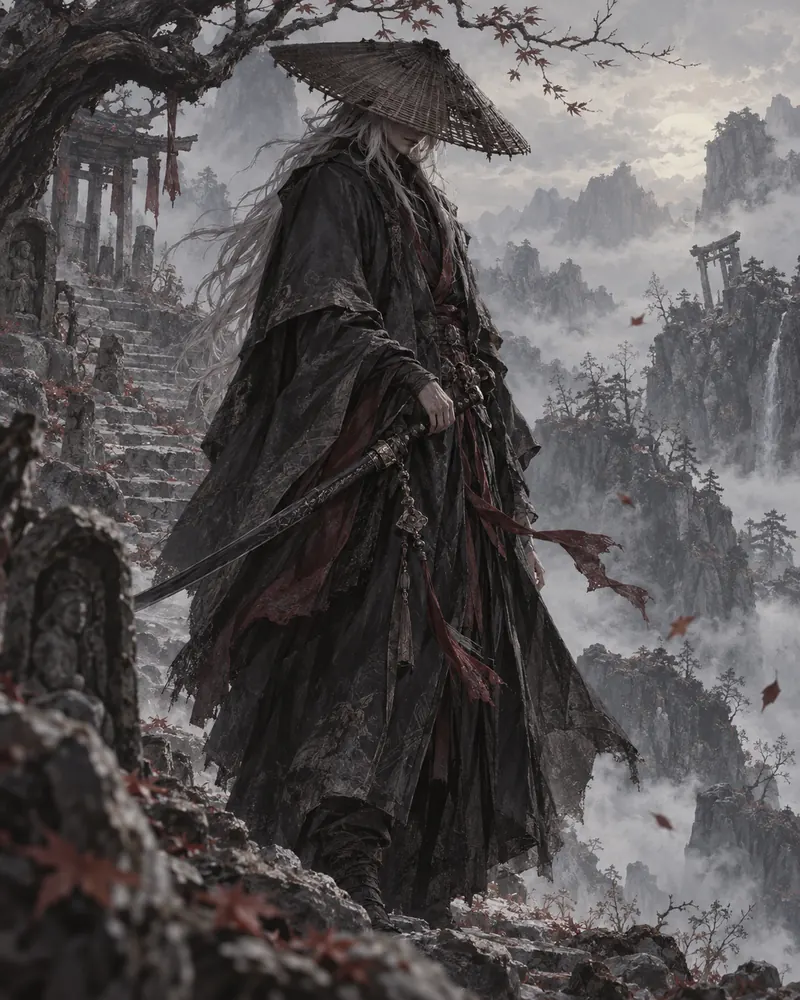
A swordsman of unknown origin and unknown teacher. Only testimony remains: that people saw the light of his sword, but never the moment it was drawn.
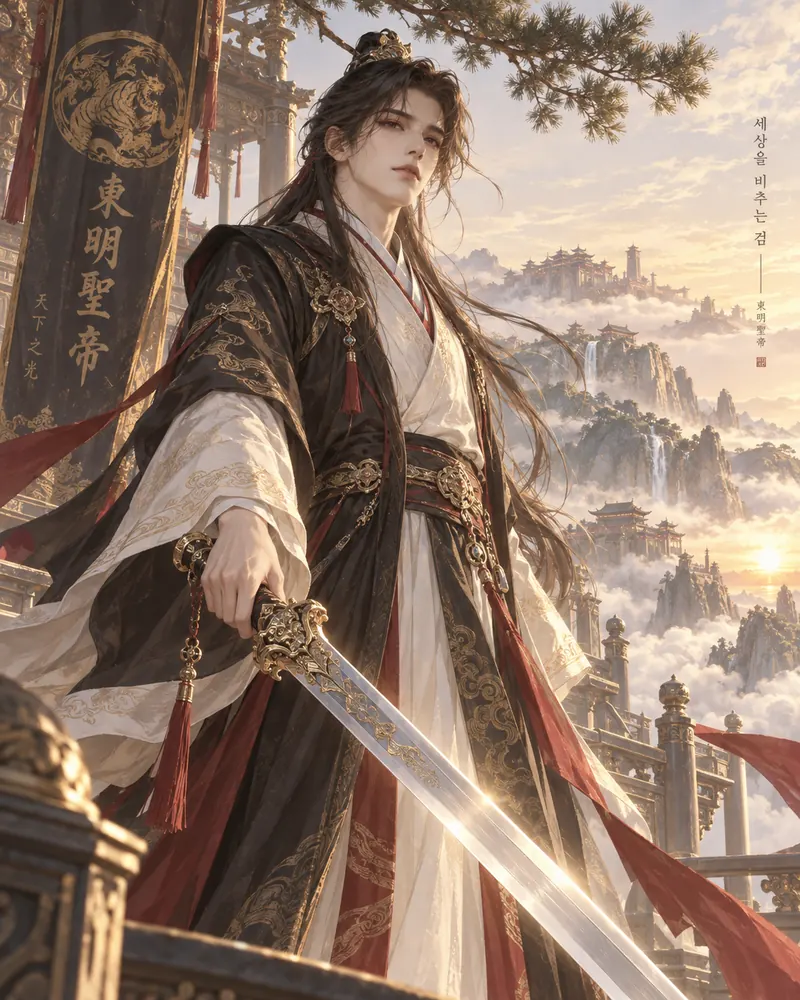
A sovereign of the East and an inheritor of the Mystic Gate. His sword had no fixed form, and there is scarcely a record of anyone seeing the same move twice.
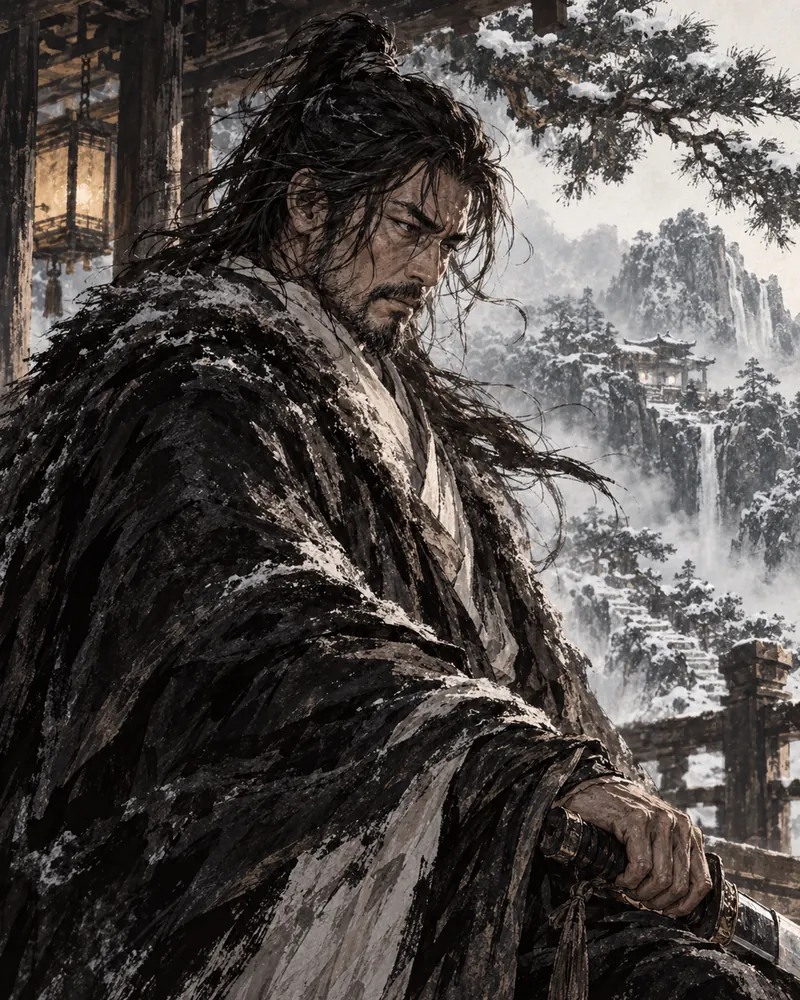
Heir of the sword demon Dugu Jiupai. He did not fixate on blocking; the instant the first blade moved, he cut off the road to the second.
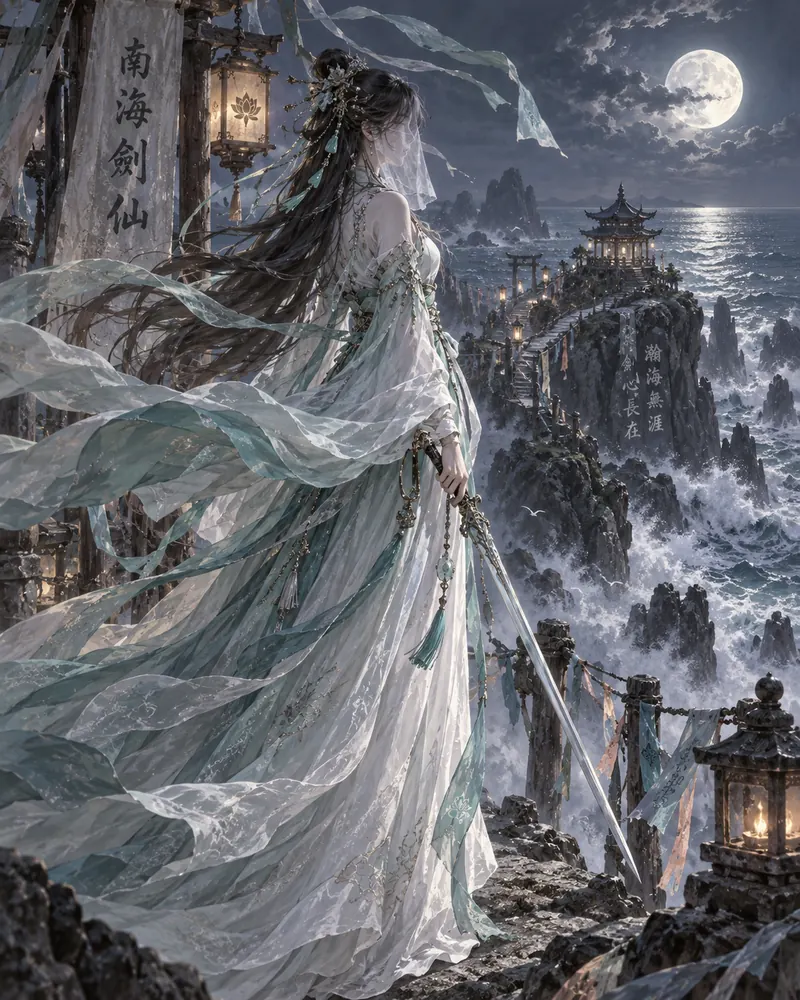
Within a sword dance that began like a ritual, an opponent's force lost its direction, turned, changed, and came back to its owner.
It is not that there is no form. It is only that it has not been decided yet.
How many times the four actually met, and who defeated whom, differs from record to record. Some say the White Ghost and the Venerable crossed swords many times; some write that the Sword Immortal turned the White Ghost's swift blade back on him. Another says that on that day the Sword Immortal's sleeve was cut by an inch.
THE AGE OF GATES
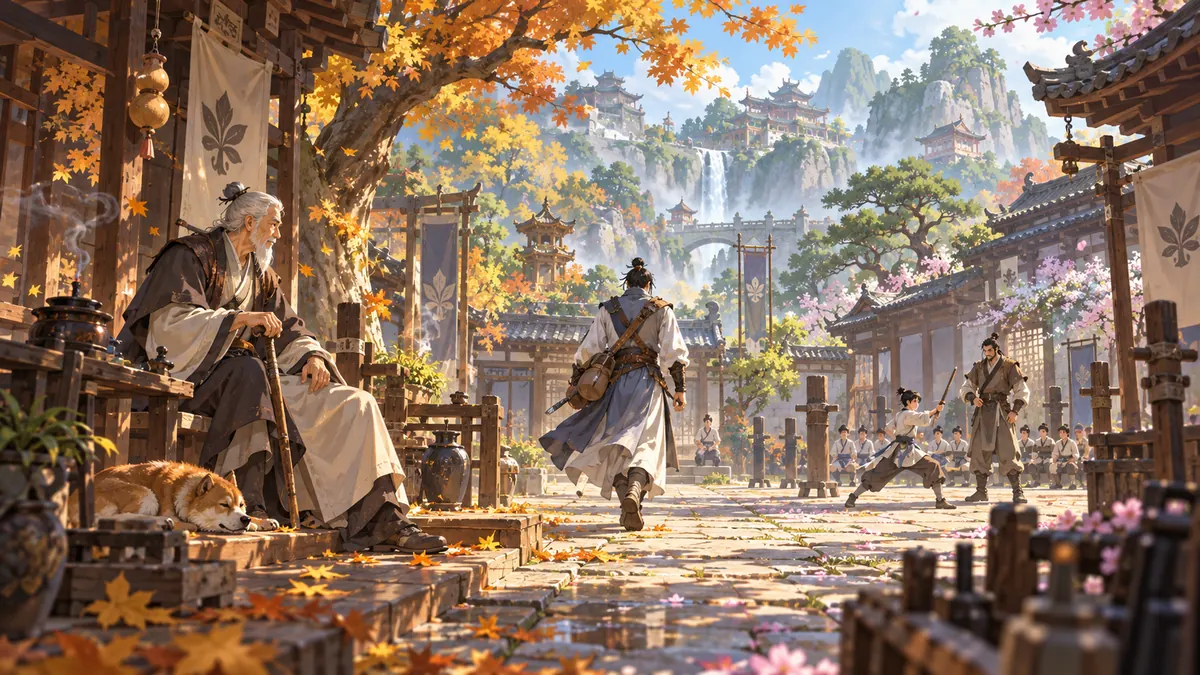
After the age of the Four Sword Absolutes the jianghu gradually changed. More than the name of one outstanding person, what mattered was the power of sects and transmissions that could preserve an art for centuries.
Shaolin's arts, inheriting Bodhidharma's teaching, grew more systematic, and Zhang Sanfeng set the principles of yin-yang and taiji upright again in his own way. Wang Chongyang and the Quanzhen lineage left deep traces in Zhongnan and in several Daoist lines. Huashan and Emei, Kunlun and Kongtong, Qingcheng and Diancang likewise built up their arts across generations, each on its own mountain and in its own region.
They were not allies from the start. They duelled, competed for disciples, and fought over manuals and legitimacy. But over long ages a common order formed, one that valued lineage, transmission and a sect's rules above all else.
That order preserved a great many arts. It also created the people who stood outside it.
The sects are a hundred, but the human body is one.Sima Xue · 司馬學
司馬先生
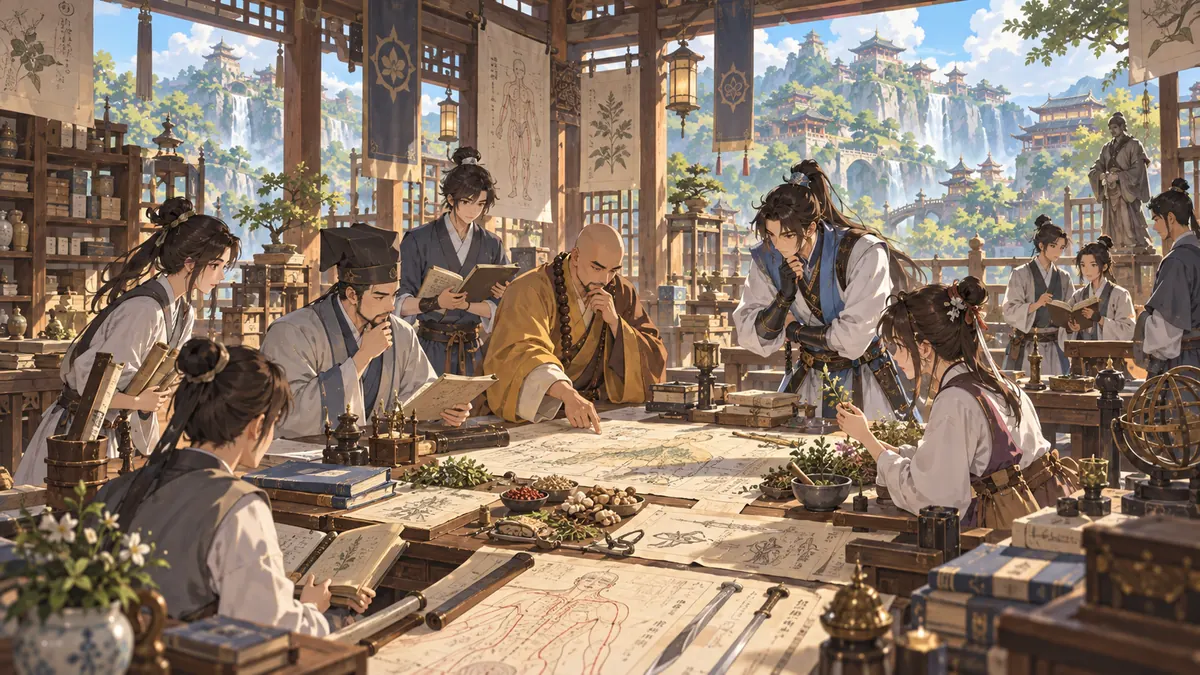
Sima Xue was not the foremost master under heaven. He was closer to a physician and a scholar of martial learning. He treated the internal injuries of Shaolin monks, examined the torn meridians of a Kongtong fighter, and cured the qi deviation of nameless wanderers.
After decades of looking inside the bodies of people who had trained in utterly different arts, he left behind a very simple sentence: 'The sects are a hundred, but the human body is one.'
Those words were a spark to the young. Why should Shaolin circulation and Wudang circulation not be studied together? Why are the arts of small sects held to be worthless? Why should birth and lineage decide which manuals a person may learn from?
People gathered around Sima Xue — physicians, scholars, wandering fighters, leaders of small sects, and disciples who had left the great schools — and began laying out their arts side by side to compare. Rather than asking which art was stronger, they asked why it worked the way it did.
Can several inner forces be circulated together? Why do opposing energies conflict? How far can meridians be changed? Can a dying master's power be passed to a disciple? Is poison always harmful, or can it be medicine?
Later generations called this period the Age of a Hundred Schools.
血天敎
At first it was a circle of researchers. But as the numbers grew, disciples appeared and quarters were built, and it became a vast community of martial learning. Its name was the Blood Heaven Sect, 血天敎.
Today people hear that name and think first of a demonic cult. But the Blood Heaven Sect at the beginning was not a group out to conquer the world. They were people who wanted to see martial learning not as the property of a few sects but as one road open to human inquiry.
The trouble was that their research began to reach into dangerous territory: how to hold several inner arts in one body; how to circulate blood qi directly; how to raise instantaneous output through reversed meridians; how to transfer power to another person; how to change constitution and meridians with poison and medicine.
Inside the Nine Great Sects, voices of caution grew louder. At first it was a question of safety. But as the Blood Heaven Sect grew and even disciples who had left the great schools flocked to it, the conflict took on another shape. Who holds the right to teach martial arts? Whose permission is needed to study the principles of the higher arts? Is a disciple who leaves a sect and teaches what they learned elsewhere a traitor?
At last the Blood Heaven Sect was declared heterodox. It began with a ban on contact and the confiscation of manuals. But the further the orders travelled into the provinces, the coarser their meaning became. People who had traded with the sect lost their businesses; people were thrown out of inns for nothing but having trained there.
We are not hunted because we sinned. We became sinners because we were hunted.
In the end, blood was spilled.
TWO ROADS
It was not outside pressure alone that broke the Blood Heaven Sect. Opinion split inside as well. Some held that they must keep talking with the world to the last; others thought the talking was already over. Those who said the dangerous research must stop fought with those who said greater power was needed instead.
In the end the Blood Heaven Sect fell. Those who survived looked at the same defeat and drew opposite conclusions.
血陰密敎 · The Blood Yin Esoterics
They developed poison and blood qi, meridian arts and meridian-stripping, concealment and infiltration, and vanished from the world's sight.
修羅魔宮 · The Asura Demon Palace
Pursuing demonic qi, reversed meridians and output beyond the body's limits, they wanted power enough never to kneel to anyone again.
血魔
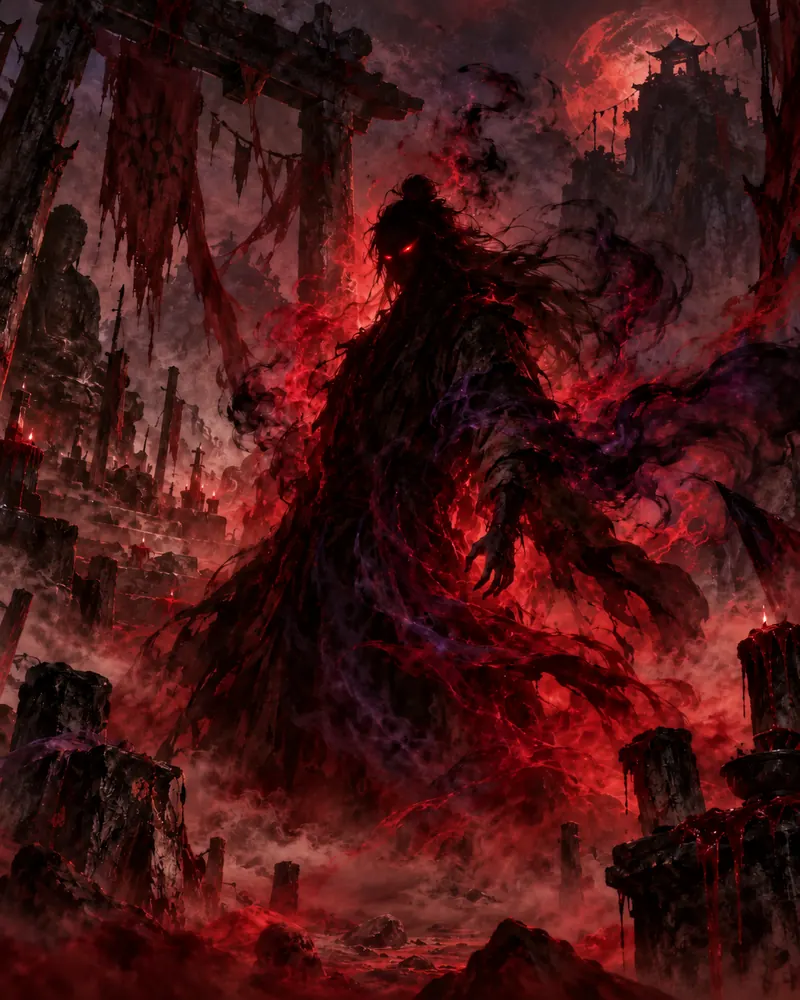
Long ages later again, an extraordinary figure who understood both lineages appeared in the jianghu. Later generations called him the Blood Demon, 血魔. But he was not the Blood Demon from the beginning.
The first thing he saw in the jianghu was not a demonic art or a manual. It was people. Expelled disciples. Survivors of ruined minor sects. Fighters no one would take in because they had no school. People suspected all their lives for the crimes and the birth of their parents. Children with the talent to learn but no way to meet a teacher of name.
The Blood Demon never asked them which sect they came from. He asked one thing instead — 'Why do you want to be strong?'
People gathered around him. He had no intention of founding a sect. But once those with nowhere to go were gathered in one place, the world began calling them a dangerous group again. When they started to be attacked, he finally raised a name — the Asura Blood Sect, 修羅血敎.
In the Asura Blood Sect, birth and bloodline did not matter. What it demanded instead was ceaseless discipline and self-examination. To them 'Asura' did not mean slaughter. It meant the strongest enemy a person must fight all their life: the fear and desire, arrogance and hatred inside themselves. And 'Blood' meant the same blood that runs in everyone.
Is the blood of a king red and the blood of a commoner black?
血氣
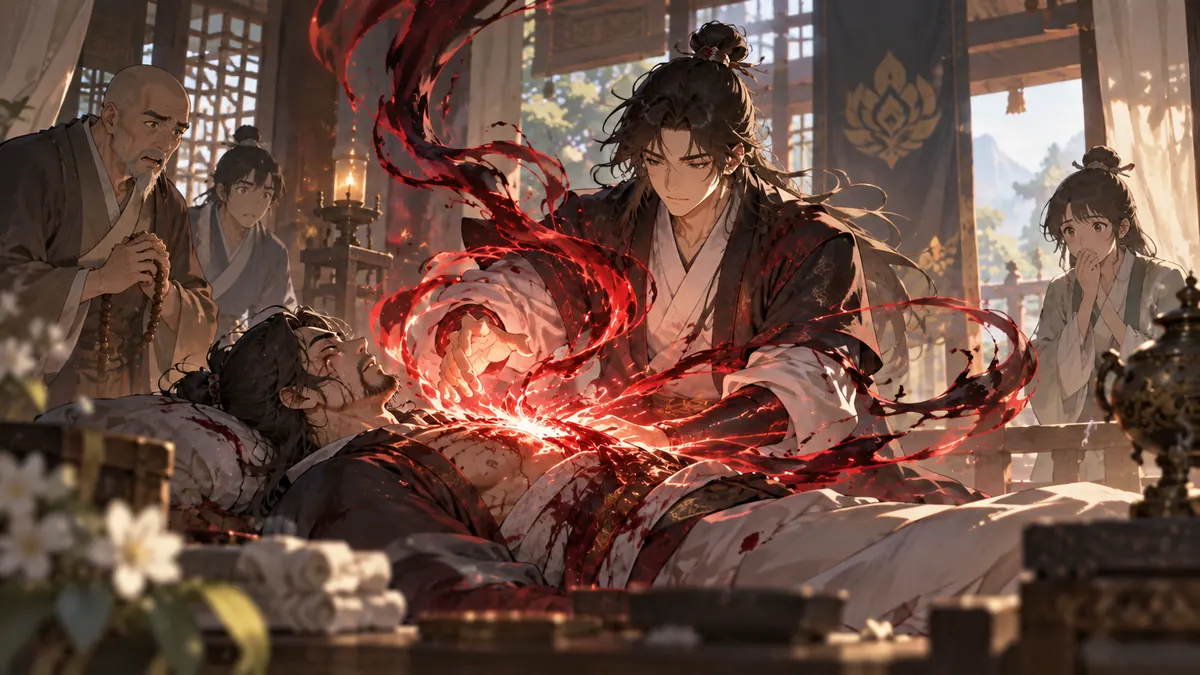
Instead he demanded greater responsibility from those who used them. He preserved the Blood Yin meridian-stripping art too, but forbade taking the power of a living person by force.
The Asura Blood Sect grew quickly — not because it was conquering the world, but because people with nowhere to go kept arriving. To the Nine Great Sects the sight looked like the old Blood Heaven Sect returning in a stronger form.
When you cast them out they were not yours. Now that I have taken them in, are they yours again?
The talks broke down. The Blood Demon had never wanted war. Records remain that he emptied strongholds several times, withdrew his people, and sent word that neither side should cross into the other's territory. But the campaign against them did not stop.
One day one of the Asura Blood Sect's refuges was surrounded. Inside were not only fighters but the wounded and the old, children and families. That day, it is said, the Blood Demon walked out alone.
That day the leader did not raise a sword against the world. He stood between the world and us.
血天大亂
As the war dragged on, the Asura Blood Sect could not keep its original shape intact either. Those who lost family and comrades wanted revenge, and some used the forced meridian-stripping the Blood Demon had forbidden. The poison arts of the Blood Yin line grew crueller, and the fighters of the Asura Demon Palace drew out power even at the cost of wrecking their own bodies.
The Nine Great Sects changed too. It began under the banner of stopping dangerous transmissions, but with time the voices calling for the other side's total destruction grew louder.
After the war, a tangled set of events was tidied into a few lines of record.
The Blood Demon, arch-fiend of the ages, led the Asura Blood Sect in a bid to conquer the world, and the heroes of the Nine Great Sects put them down.
The first generation must have known that the sentence did not explain everything. But as generations turned, memory simplified. The war between the Asura Blood Sect and the Nine Great Sects became a war between the orthodox and a demonic cult, and a man who fought to protect people was left as an arch-fiend who coveted the world.
Most young martial artists today believe it as fact. They are not lying. They were simply taught that way.
Yet leaf through the old documents and records remain that are never explained. A letter of negotiation said to have been sent by the Blood Demon. The internal rules of the Asura Blood Sect. The conflicting diaries of Nine Sect masters of the time. The testimony of refugees. And strangest of all — nowhere is there a record that anyone confirmed the Blood Demon's body.
In the jianghu, 'lost' often means the same thing as 'not yet found'.The chronicle is not finished
The transmissions of the Four Sword Absolutes, the traces of the Mystic Gate, the arts that split off from Blood Heaven — all are recorded as lost. But in the jianghu, 'lost' often means the same thing as 'not yet found'.
A page of an old manual, an odd footwork in some old man, one stroke from a nameless swordsman, a single pattern left on a ruin — any of them can pull a story of centuries ago back into the present. And it is in exactly such an age that your story begins.