陰陽 · Yin-Yang conflict
Extremes of yin and yang
What matters is how far you can control energies of opposite nature. With high harmony and control, room opens to handle both.
 ONLINE
SYSTEM GUIDE · 04
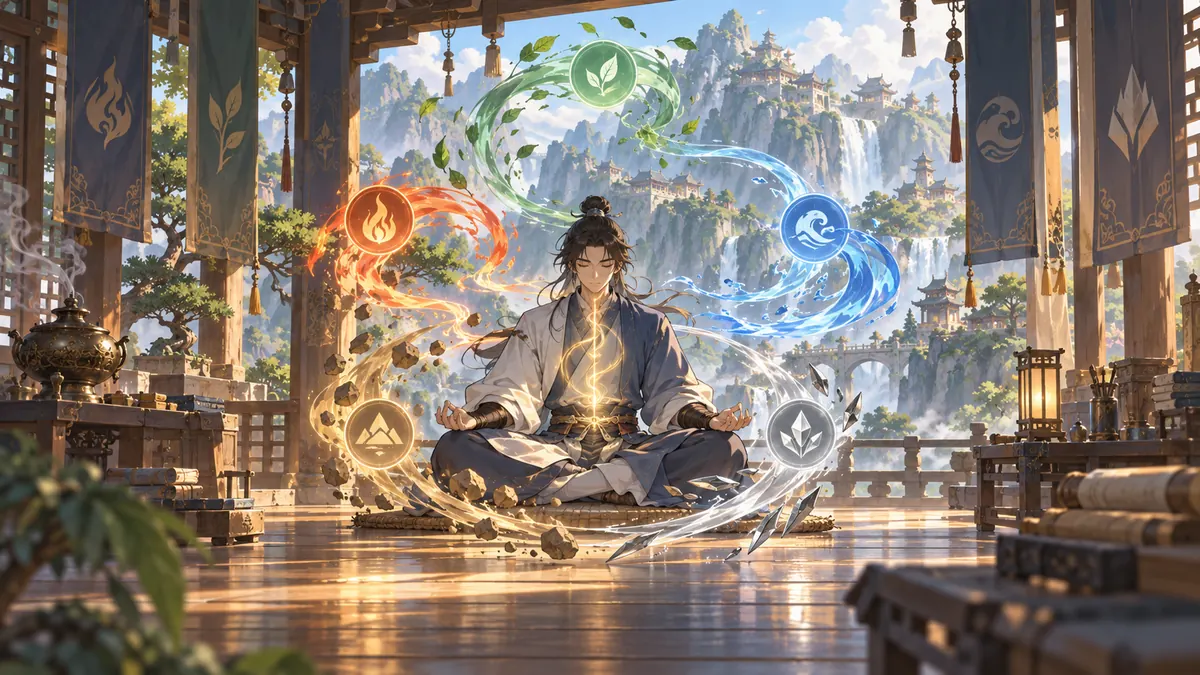
Inner arts, the five phases, yin and yang, innate frame and qinggong do not stand apart — they connect into a single martial ecology.
Systems Inner Force & Ecology
It is not a matter of choosing one inner art and simply growing the amount of your inner force. In Kangho Online, inner force means holding several energies in one body, and how those energies mesh with your arts is treated as one line of growth.
A person can learn several inner arts. But each differs in yin and yang, in the five phases, in the direction of circulation, in the purity and aggression of its qi, and in the burden it places on the meridians. Inner arts that suit each other circulate naturally, but pushing energies of opposite nature into one body unprepared creates conflict.
CONFLICT
陰陽 · Yin-Yang conflict
What matters is how far you can control energies of opposite nature. With high harmony and control, room opens to handle both.
五行 · Five-phase conflict
Matching phases or a generating relationship makes circulation a little more natural; forcing a strong overcoming relationship at high exertion can greatly increase the strain on the body.
運氣 · Circulation conflict
Handling opposing circulation methods at once makes meridian stability and qi control critical.
異質眞氣 · Foreign qi
Arts that take in another's power can be formidable, but unrefined foreign qi accumulates and becomes a source of conflict.
Energies that clashed at first can, with high control, stability and enough mastery, be suppressed, made to coexist, and carried toward greater harmony. Force high exertion without that preparation and you invite internal injury, aura collapse, and in severe cases qi deviation.
ORDER MATTERS
先 · Deeply mastering one first
If you master one inner art deeply until your foundation and control are firm and then take in an art of the opposite nature, any conflict is likely to stay within a range you can govern.
竝 · Both at once
If you take in energies of opposite directions while both inner arts are still unripe, your control cannot keep up. Learning both at once in the middle of your growth can be especially dangerous.
SWITCHING
You circulate one inner art at a time. Switch to another and the first art's unique power goes to rest, but what has soaked into your body does not all disappear.
| Kind of effect | Art being circulated | Art at rest |
|---|---|---|
| Unique power | Works in full. An ability belonging to that art alone, such as absorbing energy or redirecting force. | Does not work. |
| Effects absorbed into the body | Works in full. | The deeper your mastery, the more of it carries over — things like the stability of the meridians or adaptation to foreign qi. |
| Changes to the body | Already carved into the body. | Kept for the rest of that life even after you switch — things like changes to the meridians or growth in maximum inner force. |
WHAT ARTS DO
北冥 · Absorption
Takes in part of the energy an opponent releases or touches you with as your own. You can take in only as much as the gap in inner force and the room in your qi sea allow. The Northern Darkness Art is the prime example.
吸星 · Seizure
Fast and powerful, but the seized energy is impure, which raises the risk of foreign-qi conflict. The Star-Absorbing Method is the prime example.
淨化 · Purification
Refines the unfamiliar energy you have taken in into your own qi. Without enough purification, the meridians fall into disorder and internal injury follows.
乾坤 · Redirection
성공하면 무너짐과 경직이 줄어듭니다. 다만 힘의 차이가 아주 크면 흘릴 수 없습니다. 건곤대나이가 대표적입니다.
調和 · Harmony
Generating is not an effect that inflates power; it works by steadying the energy inside the body and raising its efficiency.
易筋 · Qi sea and meridians
Widens the qi sea that holds your inner force, or makes the meridians sturdy. Especially important for a martial artist learning several inner arts. The Sinew-Changing Classic is the prime example.
胎息 · Concealing presence
Reduces how much your presence and exertion show outwardly. A way to hide your strength in a jianghu where an opponent's details are not shown.
內傷 · Internal injury
Accumulated internal injury hampers inner-force recovery, meridian stability and high-exertion circulation.
獅吼 · Intimidation
Rather than numerical damage, it makes enemies hesitate to attack, fall back or flee. The Lion's Roar is the prime example.
五行相剋
If your element overcomes your opponent's, you have a greater effect on life force, aura and status effects alike; if it is the other way round, the effect is reduced.
THREE LAYERS
一 · Common principle
Matching phases, generating and overcoming, and qualities such as stability, flow and aura-breaking act across all arts alike.
二 · Sect lineage
Formal transmissions from the same sect share a training vocabulary and circulation method, which makes for natural links in mastery and chaining.
三 · Specific synergy
Particular attack arts, inner arts and qinggong interact in their own ways. Not every combination is treated as the same advantage.
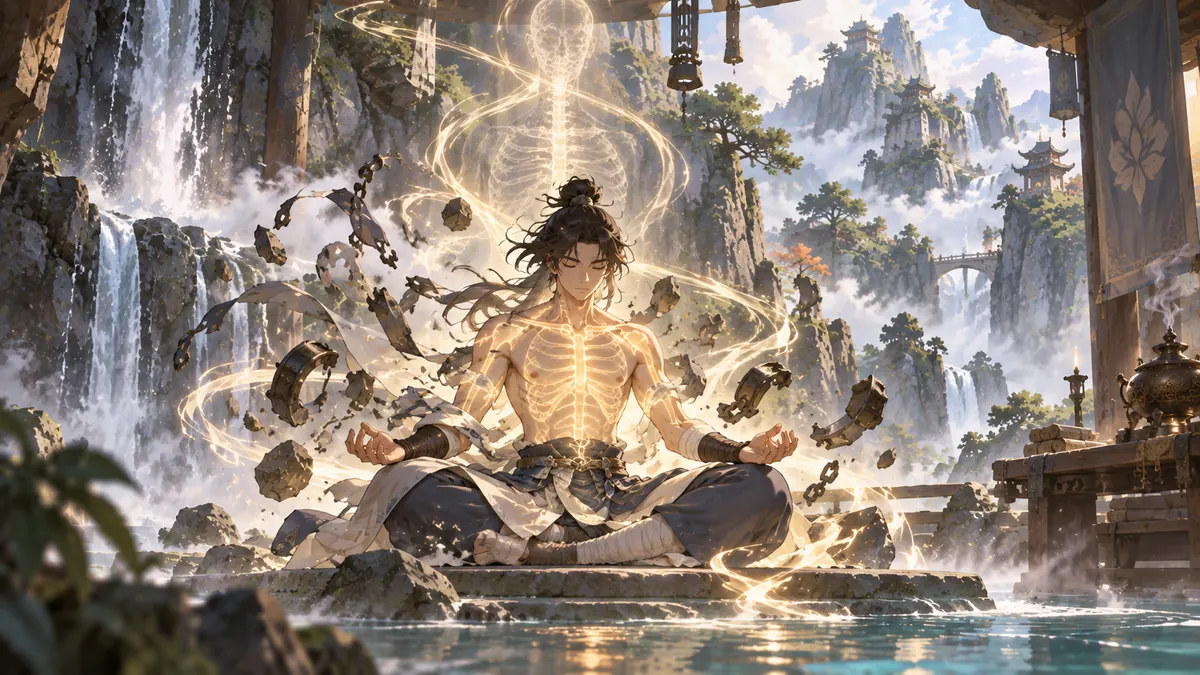
The nature of your present innate frame gives a small boost to the core handling of arts that suit it. Hardened and adamant frames sit more naturally with aura and aura-breaking arts; supple and light frames with flowing and pursuing arts.
But no single innate gift decides an art's performance outright. Mastery, inner force and actual handling are designed to carry the larger share.
Pursuit-type qinggong helps mobile arts chase; disruptive footwork widens the opening for a counter after an evasion. Agility is not movement speed — the character of movement and pursuit belongs to qinggong itself.